
Credit Education Center
Knowledge is your best financial tool. Our lending experts break down how credit works, how auto loans affect your score, and what you can do to build a stronger financial future.
Knowledge is your best financial tool. Our lending experts break down how credit works, how auto loans affect your score, and what you can do to build a stronger financial future.
Michael has spent 15+ years in consumer auto finance and holds the Certified Consumer Credit Counselor designation. He has personally guided thousands of borrowers through the lending process.
Last updated: August 2026 | Reviewed by the United Auto Credit Editorial Team
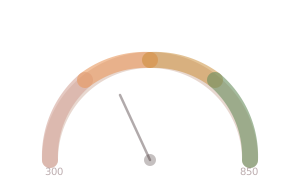
Your credit score is a three-digit number — typically ranging from 300 to 850 — that summarizes your credit history for lenders. The most widely used scoring model is the FICO score, which weighs five categories of information from your credit report:
Lenders generally categorize credit scores into tiers. Understanding where you fall helps set realistic expectations about your financing options:
| Credit Tier | Score Range | Typical Impact on Auto Loans |
|---|---|---|
| Excellent (Super Prime) | 781 – 850 | Lowest interest rates, best terms available |
| Good (Prime) | 661 – 780 | Competitive rates from most lenders |
| Fair (Near Prime) | 601 – 660 | Moderate rates; some lender restrictions |
| Poor (Subprime) | 501 – 600 | Higher rates; specialized lenders required |
| Very Poor (Deep Subprime) | 300 – 500 | Limited options; lenders like United Auto Credit specialize here |
At United Auto Credit, we serve consumers across the full subprime spectrum — including those with scores below 500 or no score at all. Our Common Sense Override approach means your number is just one part of the picture.
An auto loan is an installment loan — a fixed amount borrowed and repaid in regular monthly payments over a set term. When managed responsibly, it can be a powerful credit-building tool:

Important: A hard credit inquiry occurs when you formally apply for a loan. This may temporarily lower your score by a few points. However, if you complete all your auto loan shopping within a 14-day window, multiple inquiries are typically treated as a single inquiry by scoring models — so shop around without fear.
Whether you're recovering from bankruptcy, divorce, medical debt, or just starting fresh, these proven strategies can help you rebuild your credit profile over time:
Before signing any auto loan agreement, make sure you understand these key terms:
Refinancing replaces your current auto loan with a new one — ideally at a lower interest rate. It can be a smart move when your credit score has improved, interest rates have dropped, or your financial situation has changed. Many United Auto Credit customers who start with a subprime loan are able to refinance at a better rate within 12 to 24 months of consistent on-time payments.
Refinancing Checklist: Before refinancing, verify that your current loan has no prepayment penalty, ensure your credit score has improved enough to qualify for a meaningfully lower rate, and check that the savings from a lower rate outweigh any fees associated with the new loan.
This educational content is created by certified lending professionals with decades of combined experience in consumer auto finance. We update this guide regularly to reflect current lending practices and credit scoring models. Our goal is to empower consumers with the knowledge they need to make informed financial decisions — regardless of their current credit situation.
Ready to see whhere can offer? Pre-qualify in under 5 minutes.
Check Your Options